
AI Implementation done wrong: How an obsession with LLM's is undermining the teams running the business
Welcome to Road to AI, your weekly briefing on the biggest stories shaping the future of artificial intelligence.
🤖 Here is what we’re serving you today:
Main course
What happens when executives trust ChatGPT more than the people they manage
The dessert (from our channels to yours):
It seems that Meta’s AI is getting better at reading your thoughts and it will be able to translate brain scans into coherent sentences
Japan has an answer for its worker shortage - an AI model for 10 million robots
Crypto exchange OKX wants AI agents to hire and pay each other
Ford rehires human engineers after AI fails to match quality checks
Bank of England reviews AI rules for agentic AI in finance
Claude Fable 5 will be back online, says Anthropic

When the LLM becomes the company’s consigliere
Imagine you showed up in the office one day, excited to talk to your boss about a raise after you finally closed that account everyone else gave up on.
While proudly presenting your case, you see his facial expression suddenly doing this:

He cuts you off in the middle of the sentence saying: “Look, since we’ve had AI running long enough to gather all our company data, I ran a few things by it and decided the raise is off the table. Also AI realised we don’ really need a senior lead on this anymore. In fact, starting Monday, it seems the best thing for the company would be if you take on an entirely different role.
While it may sound surreal to you reading this, there are a lot of cases in the corporate world where executives still believe improving business with AI just means paying the monthly license for an LLM, feeding company data into it, and expecting it to become their personal Winston Wolf. (Spoiler alert, still never happened anywhere).

Believe it or not, there was actually a case reported recently in Futurism magazine where a startup CEO started to treat an LLM as his personal “consigliere”.
He let the algorithm influence major decisions like pivoting into an entirely different industry, completely bypassing any actual market research or client demand.
How exactly do we get to a point where the person in charge and managers decide a language model understands the business better than the people actually working there?
The illusion of a shortcut
Despite countless case studies showing you need a comprehensive strategy to make business operations better with AI, it seems executives are entirely convinced they can somehow hack the system and run a productive business using just the short term productivity boosts LLMs offer.
But all the new data tracking actual business gains from AI points out the exact opposite (in 2026 only 20% report measurable revenue growth or significant, transformative ROI from their formal AI investments).
Avoiding the financial commitment of a real strategy and risking it all on a DIY approach will actually just make things much more expensive in the end.
We are looking at a situation where leaders and managers are flying completely blind. Just look at the numbers.
A recent survey by ResumeBuilder shows 94% of managers now admit they are letting AI directly influence their decisions on promotions and layoffs.
“You think about a manager just asking ChatGPT, ‘Hey, who should I lay off?’ That, I think, is really scary,” said ResumeBuilder’s Rikin Pandey, according to CBS News.
On top of that, around one third of corporate executives are actively making strategic business choices based entirely on LLM outputs without any formal training on how these models actually function.
And when you look at how these numbers play out in an actual office, you see bosses using these tools to validate decisions they already made.
Instead of dealing directly with staff, they routinely copy-paste internal department conversations into ChatGPT to check if they handled a situation correctly.
They are asking algorithms to evaluate performance reviews, decide who gets a raise and even who gets fired.
In one case, an executive bought paid LLM subscriptions for the office specifically so he could monitor the chat logs and spy on what his employees were asking the machine.
Things detach from reality even more once client feedback enters the picture. A high-level sales strategist recently quit his job after his CEO decided to use an AI tool to figure out why a new platform was not selling.
Despite talking to 15 actual clients and bringing back specific reasons why the product was not a good fit, the CEO decided to ask the AI to find everything the sales rep did wrong, and as you might expect, the LLM simply blamed the sales guy.
On top of that, the same CEO used the AI to look for new clients and became convinced they needed to target brand-new “greenfield” companies with 100 or more employees. The only problem was that market doesn’t exist in the sector they operate in.
The cost of the shortcut
Signing off on an LLM license and feeding it company data feels like progress, but it usually just delays a new set of problems, especially when leadership treats the tool itself as the achievement instead of something you actually have to learn more about and help other people get better at.
When an LLM becomes leadership’s “right hand”, the whole company ends up paying for it.
Resume Now reported that 97% of employees have asked ChatGPT for workplace advice instead of their own boss, with 63% doing so regularly, often out of fear of retaliation.
The good thing is that some companies are finally realising that using AI as Flex Tape to patch messy operations can cause drawbacks, which is why they are opting for a more strategic path, even if it’s more challenging.
Just look at how Colgate-Palmolive handled it. They realised the AI is essentially useless if the employees do not understand it.
So, they focused entirely on the people and gave them a safe environment to experiment and figure out how AI could actually help with their specific daily tasks.
They built an internal AI Hub that gave their staff the infrastructure to design custom models for their specific operational demands.
This allowed a plant manager in Greece to independently translate complex German engineering manuals to keep machinery running, while the human resources department built tools to help employees map out better career trajectories.
More importantly, they updated their corporate Code of Conduct to explicitly state that a human is always accountable for the final outcome, effectively killing the option for anyone to blame a bad decision on the algorithm.
The end point of this is that you simply can’t delegate the difficult realities of running a business to a prompt window and expect a perfectly functional company by the time you arrive at the office the next morning.
Making this actually work requires getting everyone on board to figure out a cohesive strategy together, and if you happen to be the one in the position of having to map that out, here is a piece we wrote that might help you set a solid starting point.

Meta’s AI is getting better at reading your thoughts - without cracking open your skull
Japan has an answer for its worker shortage - an AI model for 10 million robots
Crypto exchange OKX wants AI agents to hire and pay each other
Ford rehires human engineers after AI fails to match quality checks
Wait, what?

Estonian Prime Minister Kristen Michal approved a national proposal to issue AI agents their own government identification codes, separating machine identities from their human owners to strictly limit what digital systems they can access.
The “AI personal identification code” would grant agents scoped, auditable authorizations (e.g., viewing a specific record or making a fixed payment) rather than inheriting a user’s blanket access.
The proposal originates from the Eesti.ai advisory council, which oversees existing government AI deployments like the national digital assistant ‘Bürokratt’.
Estonia is uniquely positioned to trial this infrastructure, having moved 100% of its government services online by December 2024 and utilizing the KSI blockchain for public record integrity since 2012.
The current proposal lacks an official implementation date or a defined legal framework for assigning liability when an autonomous agent makes a costly financial error.
Tweet of the day
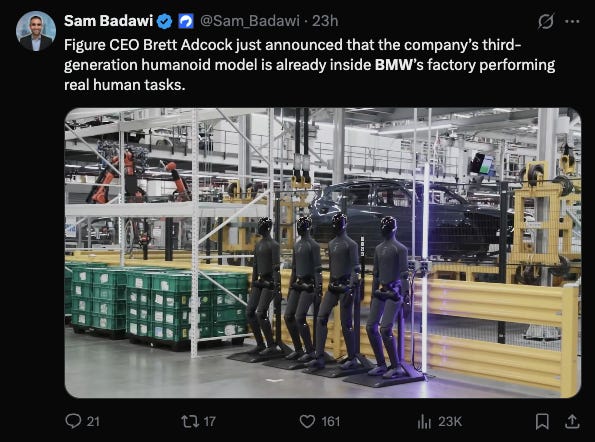
BMW Group is expanding its deployment of Figure AI's humanoid robots at its Spartanburg, South Carolina plant, introducing the newly upgraded Figure 03 model specifically for logistics and sequencing tasks after an 11-month pilot with its predecessor.
The details:
During its 2025 pilot phase, the older Figure 02 model successfully supported the production of over 30,000 BMW X3 vehicles by autonomously inserting sheet-metal parts during the welding process.
The new Figure 03 unit features major hardware upgrades, including tactile-sensor hands, palm cameras for increased dexterity, speech-to-speech audio communication, and wireless charging for higher uptime availability.
Figure 03 will initially be deployed to pick unsorted components from large containers and organize them into sequencing trolleys for just-in-time delivery to human assembly workers.
One more thing…
That’s all from us today - catch you next week. But before you leave, we have a poll for you. We will share the results in the next edition.
P.S. Did someone forward this to you? You can subscribe here